This post may contain affiliate links. Please read the disclosure policy to learn more.
Thank you for supporting this blog!
Guide to Different Types of Salt
Even in desserts, salt plays an important role, enhancing flavor, tempering sweetness, improving texture, and creating contrast. Most of my recipes call for some type of salt, so I put together this guide to the salts I use most often. Learn the differences between kosher salt, sea salt, table salt, seasoned salt, and other kinds of salt commonly used in baking and pastry recipes.
Kosher Salt
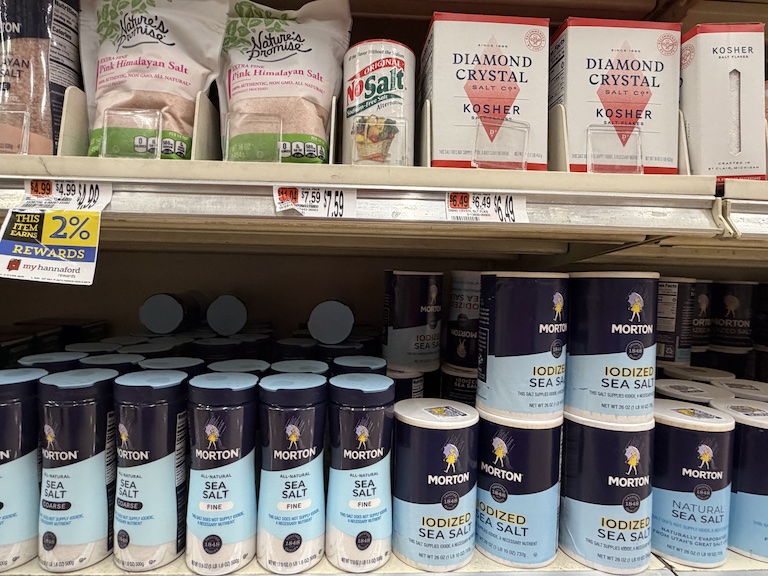
Kosher salt is a type of salt known for its ability to dissolve evenly. The industry standard is Diamond Crystal kosher salt, and this is the brand I use to test all of my recipes—if I call for kosher salt, I tested the recipe with Diamond Crystal. You can replace kosher salt with table salt or fine sea salt but you’ll want to use half as much by volume to avoid an overly salty finished product.
Sea Salt
Sea salt is made by evaporating seawater. It comes in several textures, including fine, coarse, and flaky. Fine sea salt is suitable for baking and cooking, including as a replacement for table salt or kosher salt. Coarse sea salt is often used for seasoning, or as a finishing touch for salty-sweet recipes, like salted caramels). Meanwhile, flaky sea salt is great for sprinkling over baked goods like focaccia to create texture and flavor, or as an ingredient in spice blends like everything bagel seasoning.
Table Salt
Table salt is a finely ground, highly refined salt that typically contains added iodine and anti-caking agents. In the US, Morton’s is the most recognizable brand. I generally only use table salt for filling the salt side of my salt and pepper shaker set, but it will work in baking as a substitute for kosher or fine sea salt. Because it is denser than kosher salt, use half as much product by volume.
Pickling Salt
Pickling salt (sometimes labelled canning and pickling salt) contains no iodine or anti-caking agents, allowing it to dissolve quickly into brines. It’s primarily used for pickling, quick-pickling, canning, and brining. I often skip it and use kosher salt for my pickling recipes—as a pastry chef I don’t pickle things terribly often, and it’s easier and more efficient than purchasing a product specifically for pickling. For example, I developed my refrigerator pickle recipe using kosher salt, but you can replace it with pickling salt if you wish.
Pink Himalayan Salt
Pink Himalayan salt is a rock salt mined from ancient salt deposits. Known for its pale pink color, which comes from trace minerals, you’ll sometimes spot pink Himalayan salt in tabletop grinders at restaurants and pizzerias. It’s sold in fine and coarse grinds and can be used for cooking and baking, or for finishing dishes much like sea salt. I like to sprinkle it on top of my chocolate focaccia.
Seasoned Salts
Occasionally in my savory baking or main dish recipes, I’ll call for a seasoned salt, such as celery salt (a key ingredient in Amish macaroni salad) or onion salt. You can also buy a product called “seasoned salt” which contains a blend of salt and spices like paprika, garlic, onion, and herbs. Because of these added spices and flavorings, seasoned salts are generally not a good substitute for plain sea, table, or kosher salt.

Rebecca Frey is a freelance recipe developer, food writer, photographer, stylist, and pastry chef. She earned the Diplôme de Pâtisserie (French Pastry Techniques Diploma) from Le Cordon Bleu London in 2020 and an MSc in Culinary Innovation from Birkbeck, University of London in 2022, where she focused her dissertation research on Pennsylvania Dutch recipes. She also holds a Professional Chocolatier’s Certificate from Ecole Chocolat. Rebecca has developed recipes for websites including Serious Eats, The Spruce Eats, Wine Enthusiast, and others. Follow her on Instagram @bastecutfold.