Florentines (Fruit and Nut Florentine Biscuits)
This post may contain affiliate links. Please read the disclosure policy to learn more.
Thank you for supporting this blog!
These homemade florentines feature a mix of flaked almonds, glacé cherries, candied citrus peel, and raisins, all caramelized together to form a sweet and chewy fruit and nut biscuit. Finish with a dunk in dark chocolate for the ultimate treat!

What Inspired This Florentine Recipe?
Florentines are small biscuits (cookies) made from a mixture of nuts, candied fruits, and honey, spooned into silicone molds and baked in the oven until caramelized and golden brown, then finished with a drizzle or dunk in dark chocolate. Delicate fruit and nut florentine biscuits likely originated in Italy, although the exact history remains something of a mystery. Some say they were first created in Florence (hence the name!) but it’s just as likely that they got their start in 17th century France. And in fact, I learned to make these at French pastry school, during Basic Pâtisserie at Le Cordon Bleu.

That day, we made florentines along with other pastry classics like macarons and Nancy macarons. My first-ever attempt at macarons was a complete and total disaster, but luckily the florentines fared much better, and these fruit and nut biscuits quickly became a personal favorite. Like macarons, florentines are slightly finicky, but well worth the extra effort.

Key Ingredients for Making Florentines
- Nuts – You’ll need flaked almonds or sliced blanched almonds, along with about 15 grams of chopped walnuts or pistachios, or a mix of the two. Unfortunately, because the nuts form the base for these cookies, there really isn’t a way to make nut-free florentines. Do not use whole nuts. They won’t fit in the mold and are difficult to chew.
- Candied Mixed Peel – Cut mixed peel (a blend of tiny pieces of candied orange and lemon) features prominently in many British recipes. If you can’t find mixed peel locally, you can order it from Amazon, substitute finely chopped homemade candied orange peels instead, or make your own homemade mixed peel from scratch.
- Glacé Cherries – Glacé cherries are sticky and dry, not wet like maraschino cherries. They’re sometimes sold as “candied cherries,” “cherry halves,” or “holiday fruit.” Save the rest for Christmas puddings or cherry cola truffles.

- Sweeteners – A blend of caster sugar, honey, and light corn syrup creates the sweet, chewy, caramelized biscuit base. For corn syrup I prefer the Golden Barrel brand, but you can substitute another invert sugar instead.
- Raisins – You can use raisins, or a mix of raisins and dried cranberries. (I like to toss in the leftovers from my cranberry orange scones.) Sultanas and currants will also work.
- Dark Chocolate – Choose a good-quality couverture for dipping the florentines. For notes on tempering, see below.

Notes on Dried Fruit
The first few times I made florentines (including in our lesson at Le Cordon Bleu) I mixed the dried fruit into the nut and honey mixture, then baked everything in the oven. This tried-and-true method works just fine if you don’t mind the texture of cooked raisins. Otherwise, you can add a few raisins to the top of each florentine after baking. (You’ll need to act very quickly, before the sugar sets.) Thanks to Nicola Lamb over at Kitchen Projects for this excellent tip!
Choosing a Mold
At Le Cordon Bleu, we learned to make florentines in a silicone mold, and I strongly suggest you do the same. (Some florentine recipes instruct you to spoon the fruit-and-nut mixture onto a silicone mat, but I tested this method and found that the biscuits spread too much.) For this recipe, I used a fluted silicone tart mold with cavities measuring about 1 1/2 inches across the bottom. You can go slightly smaller (with a smaller mold the cookies will be a bit thicker and chewier) or larger than this, but I don’t recommend going with a mold larger than 2 inches or the biscuits will be too thin.

The depth of your mold does not matter, since you’ll only be adding a spoonful of fruit and nuts to the bottom of each cup. (The mold is mostly there to constrain the mixture so it doesn’t over-spread, rather than creating a decorative shape.) You can use something like a silicone muffin pan, or even bake in individual silicone muffin cups.

Should I Temper the Chocolate?
Tempering (heating and cooling chocolate to specific temperatures) produces shiny, fast-setting chocolate, but it requires practice. If you aren’t familiar with tempering, you can use discs of coating chocolate for this recipe. Unlike couverture, coating chocolate (also known by other names such as melting chocolate, melting wafers, confectionery coating, candy wafers, or dipping chocolate) comes ready to use, without tempering.

You can also drizzle or dip your florentines in untempered chocolate. It won’t be quite as shiny as the tempered kind, but will taste just as good. Note that untempered chocolate requires more time to set, so you might find it helpful to pop the tray in the refrigerator for a few minutes to speed the process along.


Florentines
- Total TimeAbout 1 hour
- Yield12 2-inch florentines 1x
Flaked almonds, glacé cherries, candied peel, and raisins, all caramelized into a sweet and chewy biscuit, finished with a dunk in dark chocolate!
Ingredients
45 grams flaked almonds (1/2 cup)
25 grams candied mixed peel (2 tablespoons)
25 grams glacé cherries, cut into 1/4-inch pieces (about 1 tablespoon, packed)
15 grams chopped walnuts or pistachios (2 tablespoons)
35 grams caster sugar (3 tablespoons)
20 grams honey (1 tablespoon)
20 grams light corn syrup or liquid glucose (1 tablespoon)
30 grams unsalted butter, softened (2 tablespoons)
25 grams raisins (2 tablespoons)
75 grams chopped dark chocolate (2 1/2 ounces; about 1/2 cup) for decorating, optional
Instructions
Sit a 12-cup silicone mold* on a small tray. Preheat oven to 350° F (176° C).

In a medium bowl, combine flaked almonds, candied mixed peel, glacé cherries, and chopped walnuts.


In a small saucepan, combine caster sugar, honey, and corn syrup over low heat, cooking until sugar dissolves.


Stir in the butter and allow it to melt.


Cook, without stirring, until mixture reaches soft ball stage, about 244° F (118° C) on a candy thermometer, about 1-2 minutes.


Pour hot syrup over fruit and nut mixture and stir to combine.


Spoon into silicone mold, dividing mixture evenly between the cavities.

Bake in preheated oven for 11-12 minutes, or until bubbly and lightly golden brown.
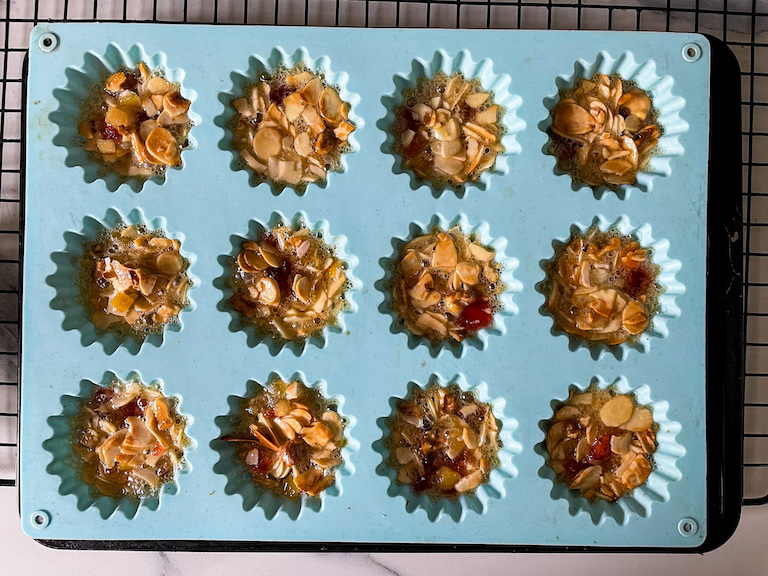

Remove from oven and immediately dot each florentine with a few raisins**, pressing down gently to secure.

Cool at room temperature for 30 minutes, or until bottom of mold feels cool to the touch. Refrigerate while you prepare the chocolate.
Line a tray with parchment or a silicone mat. Melt chocolate over a bain-marie or double boiler.

Pop the florentines from the mold.


Dip the bottom of each florentine in chocolate, then sit it, chocolate side down, on prepared tray.


Allow chocolate to set.

Store florentines in an airtight container at room temperature for up to 1 week.


Notes
*The bottoms of the cavities should be about 1 to 2 inches in diameter. Depth does not matter.
**See notes on dried fruit in the post above.
- Prep Time: 20 minutes
- Cooling Time: 30 minutes
- Cook Time: 12 minutes
- Category: Biscuits and Cookies
- Method: Stovetop + Oven

Make-Ahead and Storage Suggestions
Homemade florentines are best enjoyed within the first few days, but you can store the leftovers in an airtight container at room temperature for up to one week. I do not suggest freezing florentines.
Other Biscuit and Cookie Recipes You Might Enjoy
French Macarons
Earl Grey Cookies
Chocolate Orange Shortbread
Homemade Bourbon Biscuits
And if you do make these, or any of my recipes, don’t forget to tag me @bastecutfold or use the hashtag #bastecutfold on Instagram. I always love to see what you’re making!